Ten years ago, Pope Francis began his pontificate on the Solemnity of St. Joseph. In this note, we explain why the Pontiff chose this date, its close relationship with the Holy Custodian, some of his reflections, and how he has contributed to spreading devotion to St. Joseph, especially now that the Church celebrates the Year of St. Joseph called by the Holy Father.
On December 8, 2020, the Solemnity of the Immaculate Conception, Pope Francis published the apostolic letter Patris corde (With a Father’s Heart) on the occasion of the 150th anniversary of the declaration of St. Joseph as Patron of the Universal Church. With the letter, the Holy Father established the Year of St. Joseph, from December 8, 2020, to December 8, 2021.
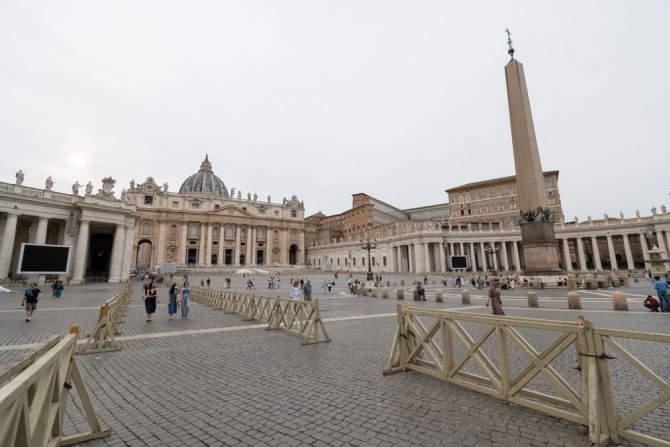
Ten years ago, precisely on Tuesday, March 19, 2013, the St. Peter’s Square in Rome acclaimed the Pope at the beginning of his pontificate. On that occasion, he said: “I give thanks to the Lord for being able to celebrate this Holy Mass at the beginning of the Petrine ministry on the Solemnity of St. Joseph, husband of the Virgin Mary, and patron of the universal Church: it is a coincidence rich in meaning.”
“The Pope, too, to exercise power, must increasingly enter into that service which has its luminous culmination on the cross; he must set his eyes on the humble, concrete, faith-rich service of St. Joseph and, like him, open his arms to guard all God’s people and welcome with affection and tenderness all humanity,” he emphasized.
Months later, Pope Francis, through a decree of the Congregation for Divine Worship and the Discipline of the Sacraments, decided to make a small modification to the prayers of the Mass to encourage devotion to St. Joseph. Specifically, with this modification, the Holy Custodian is mentioned in Eucharistic Prayers II, III, and IV of the third typical edition of the Roman Missal, placed after the name of the Virgin Mary.
Later, in a ceremony accompanied by Benedict XVI, Pope Francis consecrated the State of the Vatican City to St. Joseph and St. Michael the Archangel. On Wednesday, March 19, 2014, he referred to St. Joseph again, saying that “he is the model of the educator and the father. So I commend to his protection all fathers, priests – who are fathers, eh! – and those who have an educational role in the Church and in society.”
During his trip to the Philippines in early 2015, the Pontiff reflected on the three lessons that St. Joseph gives to families around the world: to rest in the Lord in prayer, to grow with Jesus and Holy Mary, and to be a prophetic voice in society. There he revealed one of his best-kept secrets.
“I love St. Joseph very much because he is a strong man of silence. On my desk, I have an image of St. Joseph sleeping, and while he sleeps, he takes care of the Church. Yes, he can do it, we know,” said the Holy Father. “When I have a problem, a difficulty, I write it down on a piece of paper and put it under St. Joseph so that he can dream about it. This means that he will pray for this problem,” he added.
On the return flight from Strasbourg (France) to the Vatican after his visit to the European Parliament and the Council of Europe, the Pontiff said, “Every time I have asked something of St. Joseph, he has granted it to me.”
In December 2018, in the homily of the Mass he presided over at the Casa Santa Marta, the Pope spoke about the Holy Guardian who “was said to be the shadow of the Father: the shadow of God the Father”, a man who took charge of fatherhood and mystery. “And if Jesus, the man, learned to say ‘daddy’, ‘father’ to his Father whom he knew as God, it was thanks to what he learned from life, from the testimony of Joseph: the man who guards, the man who makes things grow, the man who carries forward fatherhood and mystery, who does not take anything for himself.”
In December 2019, before the Angelus prayer, Pope Francis said that in St. Joseph, “a figure apparently in the background,” “all Christian wisdom is concentrated.” The Pope explained that when he learned that he would be the adoptive father of Jesus, “Joseph completely trusts in God, obeys the Angel’s words, and takes Mary with him. It is precisely this indestructible trust in God that has enabled him to accept a humanly difficult and, in a sense, incomprehensible situation.”
“Joseph, in faith, understands that the child conceived in Mary’s womb is not his own son, but rather the Son of God, and he, Joseph, will be his guardian, assuming full earthly fatherhood.”