In a striking personal intervention, Pope Francis has written a letter to four German Catholic laywomen who quit the German Synodal Way earlier this year.
In the letter, published in the German newspaper Welt on Nov. 21, the pope expressed deep reservations about the direction of the Catholic Church in Germany, warning that steps currently being taken “threaten” to undermine unity with the universal Church.
Chief among the pope’s concerns is a push to establish a permanent “Synodal Council,” a mixed body of laity and bishops that would govern the Catholic Church in Germany.
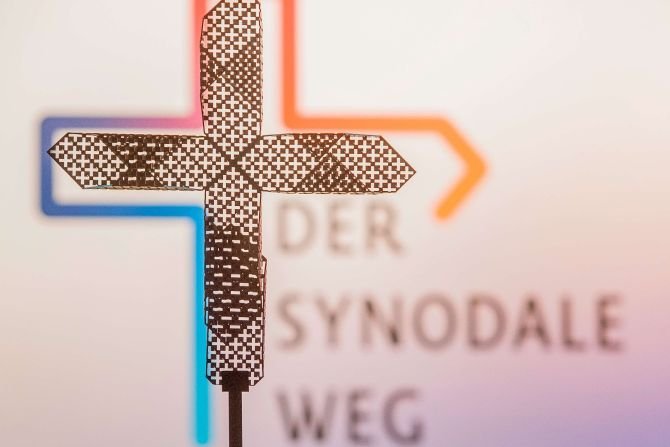
Since its launch by Cardinal Reinhard Marx in 2019, the German Synodal Way has courted controversy.
Participants have voted in favor of proposals calling for the priestly ordination of women, same-sex blessings, and changes to Church teaching on homosexual acts, prompting accusations of heresy and fears of schism.
This is not the first time Pope Francis and the Vatican have expressed reservations about the German Synodal Way, also sometimes called the Synodal Path. Here is a timeline of their interventions:
2023
November: Pope Francis responds to a letter from four prominent German women — theology professors Katharina Westerhorstmann and Marianne Schlosser, philosopher Hanna-Barbara Gerl-Falkovitz, and journalist Dorothea Schmidt — who announced they were quitting the German Synodal Way in February.
“I, too, share concerns about the numerous concrete steps that large parts of this local Church are now taking that threaten to move further and further away from the common path of the universal Church,” he says in a letter sent four days after the one he received.
January: In an interview with the Associated Press published Jan. 25, Pope Francis decries the German Synodal Way as elitist, unhelpful, and running the risk of bringing ideological harm to Church processes.
The pope says the global synod’s aim was to “help this more elitist (German) path so that it does not end badly in some way but so is also integrated into the Church.”
2022
June: Pope Francis speaks about the Synodal Way in Germany in a conversation with the editors of Jesuit journals published on June 14.
He says he had told the leader of Germany’s Catholic bishops, Bishop Georg Bätzing, the country already had “a very good evangelical church” and “we don’t need two.”
“The problem arises when the Synodal Path comes from the intellectual, theological elites and is much influenced by external pressures. There are some dioceses where the Synodal Way is being developed with the faithful, with the people, slowly,” he says.
July: The Holy See intervenes in the German Synodal Way on July 21, warning of a “threat to the unity of the Church.”
“In order to safeguard the freedom of the people of God and the exercise of the episcopal ministry, it seems necessary to clarify that the ‘Synodal Way’ in Germany does not have the power to compel bishops and the faithful to adopt new forms of governance and new orientations of doctrine and morals,” reads a statement that Pope Francis says came from the Secretariat of State.
2020
September: Cardinal Kurt Koch says that Pope Francis has expressed concern about the Church in Germany.
The president of the Pontifical Council for Promoting Christian Unity tells the magazine Herder Korrespondenz on Sept. 22 that he believes the pope backed an intervention by the Vatican’s doctrinal office in a debate over intercommunion between Catholics and Protestants.
October: According to Bishop Heinz-Josef Algermissen, Pope Francis expressed “dramatic concern” about the Catholic Church in Germany when they spoke after the general audience on Oct. 7.
The Fuldaer Zeitung reports that the pope told Algermissen that the Synodal Way was too focused on “political questions” such as the position of women in the Church and priestly celibacy.
2019
June: Pope Francis sends a 28-page letter to German Catholics on June 29 calling for a focus on evangelization in the face of the “erosion” and “decline of the faith” in the country.
In his letter, he issues a warning about the German Synodal Way, a process announced by Cardinal Marx the previous March. The pope says: “What this entails in concrete terms and how it unfolds will certainly require further consideration.”
September: In a letter sent to German bishops, the Vatican says plans for a binding Church synod in Germany were “not ecclesiologically valid.”
Cardinal Marc Ouellet, then-prefect of the Dicastery for Bishops, also sends Marx a four-page legal assessment of the German bishops’ draft statues, in which are raised a series of concerns about the proposed structure and the participants in the German Synodal Path.
It concludes that the German bishops are not planning a national synod but instead a particular Church council — something they cannot conduct without explicit Vatican approval.
This story was originally posted on CNA.