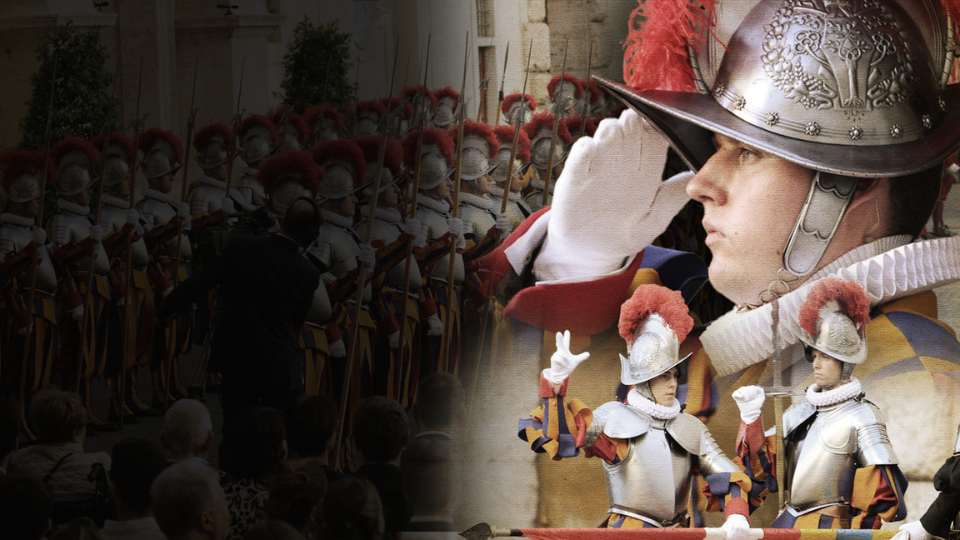
Between the morning’s Holy Mass and the evening’s swearing-in ceremony on May 6th, the new recruits received a private audience with Pope Francis in the Apostolic Palace.
“This day,” the Pope told the new Guards, “gives me an opportunity to publicly express my thanks for the presence and service of the Swiss Guard. You demonstrate a high level of motivation and willingness to serve, and I am very pleased with that. And with the good relations among yourselves. Good relations are the high road to our human and Christian growth and maturation.”
“It is not just a period of work,” he continued, “but a time, a time of life, of relationship, of intense fellowship in a diverse company. Today, it is widespread among young people to spend their free time alone, with their computer or cell phone. Therefore, I also say to you, young guards, go against the current.”
Eliah Cinotti is a Corporal of the Guard and the Communications Officer. He explained, “The Pontifical Swiss Guard has a unique atmosphere because we have the joy of being among fellow countrymen daily. So first of all, it’s a very Swiss environment. When one enters the barracks, especially the visitors, I greet those who are coming from Switzerland, and they say, ‘But wow, are we in Switzerland? Here is not the Vatican.'”
“I must say,” he added, “there is a strong camaraderie present here because we are, first of all, a huge family. We are a community, obviously a military community. Therefore, we have very high discipline. We require every single Guard to be according to the Regulations.”
In the month before the swearing-in Ceremony, the new recruits take a series of basic training tests to meet military regulations. The first on the list was the sports test.
One Guard responsible for examining new recruits’ fitness is Vice Corporal Matthias Roth.
“All recruits,” he explained, “do this when they join the Guard. It has to be passed. And if you don’t pass initially, you repeat until you pass. It is a basic fitness test where you have to have a certain level of endurance. You have to be agile but at the same time strong enough in order to pass.”
“Every guardsman is responsible for his own sporting level,” he continued. “We simply check this once a year for the troops, twice a year for the squads, and for those who also go on the papal trips. We also have a fitness room that has weights and an indoor gym. And where, of course, you can let off some steam outside of work. But it’s up to everyone to decide what they want to do.”
“You can also go cycling,” he noted, “or running in Rome. There are options for playing various sports here in Rome, including rowing crew. We have guard groups who play soccer. There are lots of different ways to keep fit.”
For some of the listed requirements, one must be Swiss, male, and above 174 cm or 5 feet, 8 inches tall to join the Guard. Although non-Swiss Catholics are excluded from joining their ranks, everyone can still learn from their training exercises and the guards’ wisdom and expertise.
“The most important thing is your own consistency,” Roth encouraged. “You must keep training every day, or at least every other day. I focus on small workouts, and you don’t have to want to go from zero to 100 straight away. It would help if you tried to build up your routine slowly with simple exercises, carrying out the exercises properly every day, or as I said, at least every other day. I believe, and I am convinced, noticing my progress too, this is ultimately the key to sporting success.”
The guards’ key engagement with the public is at the exterior posts, where they protect entrances but also welcome residents of Vatican City, answer questions from pilgrims, and distribute tickets for papal audiences.
“In the Swiss Guard,” Cinotti explained, “normally in the first 26 months, a bit of classic work is done, i.e., the protection of the Vatican, the sentry service, various, let’s say, classic services that the public doesn’t normally see. Then, after these 26 months, you can grow according to the availability of the Swiss Guard. Someone can become a non-commissioned officer and therefore begin a training course for escorting the Pope.”
Subscribe to our newsletter to get exclusive content, updates and information from the Vatican