On the via Appia Antica, beyond the Aurelian walls, sits the ancient basilica of San Sebastiano fuori le Mura. It is one of the most important churches in Rome, not only because it is one of the seven pilgrimage churches of Rome, but also because it is where the remains of Sts. Peter and Paul were taken (it was known as “Basilica Apostolorum” before it was dedicated to St. Sebastian) during the Christian persecution.
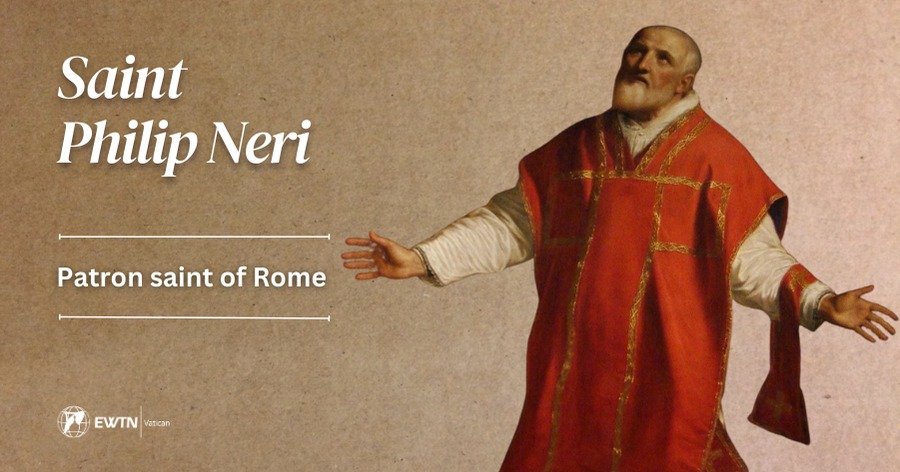
It is also here, deep in the catacombs that lie beneath the extant basilica, where St. Philip Neri had his spiritual epiphany on the eve of Pentecost in 1544. It is here where the beloved Second Apostle of Rome committed himself to a life of charity.
Early life, arrival in Rome, and the catacombs
Born in 1515 to a wealthy Florentine family, the young Filippo Neri was brought up with a classical education by the Dominicans of the Monastery of San Marco. While displaying great promise, intelligence, and business acumen he ultimately rejected his familial inheritance to follow a spiritual vocation of service. After a brief sojourn in San Germano, he arrived in Rome in 1534, which unknown to him at the time would be his final destination.
Upon his arrival, he witnessed an ecclesiastical climate that was characterized by corruption, vice, and decadence. However, it was in the Catacombs of San Sebastiano (St. Sebastian) where Neri spent hours in quiet contemplation and intense prayer.
There was perhaps no better place. After all, the silence of the catacombs (the burial site of Christians who died for their faith, among them once the remains of Sts. Peter and Paul, as well as St. Sebastian) provided a stark contrast to the squalor and vice of the streets above.
The catacombs, in a sense, were representative of the evolution of the Church’s life in Rome — persecution and dominance, faith and apostasy, splendor and squalor. Neri’s spiritual exercises stood at the intersection between the ancient and the old — a return to the earliest traditions of the paleo-Christian age, for it was this martyr’s unwavering faith, persistence, and death that paved the way for a Christian Rome.
It is fitting, then, that his spiritual epiphany happened there at Pentecost. Asking God for the gift of the Holy Spirit, it came down as a great ball of fire, entering through his mouth and settling into his heart (this experience was so intense it caused an enlarged heart and lifelong palpitations when engaging in his spiritual exercises). It is (just as it was for the Lord’s disciples in the upper room) representative of spiritual zeal — the burning fire of God’s love that animated both the apostles and, later, Neri, to go out and evangelize.
The founding of the Archconfraternity of the Most Holy Trinity
In 1540, Neri, while he was still a layman — it wasn’t until 1551, at the age of 36, that he was ordained a priest — established the Confraternita della Santissima Trinità (the Confraternity of the Most Holy Trinity), given canonical status by Pope Paul III.
It was in the jubilee of 1550 that Neri invoked what is now an archconfraternity to care for the many pilgrims who traveled from afar, especially those who were the most needy.
The archconfraternity is still active today in the Church of Santissima Trinita dei Pellegrini (built in 1614 over the site of an older church dedicated to St. Benedict), a personal parish of the Fraternity of St. Peter (an Ecclesia Dei community dedicated to the celebration of the Traditional Latin Mass). Through their numerous activities for Rome’s poor, they continue to embody Neri’s example by providing a living example of faith and charity.
A model of contemporary Christian life
St. Philip Neri holds a special place in the city of Rome’s heritage and made an indelible mark upon the spiritual life of the city and the universal Church through his founding of the Congregation of Oratorians, his popularization of the 40-hour devotion, and the Roman pilgrimage of the Seven Churches. Underscoring all of his deeds was love and charity.
In 2015, the Church celebrated the fifth centenary of Neri’s birth. On this occasion Pope Francis remarked: “St. Philip Neri also remains a luminous model of the Church’s ongoing mission in the world. The perspective of his approach to neighbor in witnessing to all to the love and mercy of the Lord can serve as a valuable example to bishops, priests, consecrated people, and lay faithful.”
This article was originally published on CNA (Catholic News Agency)