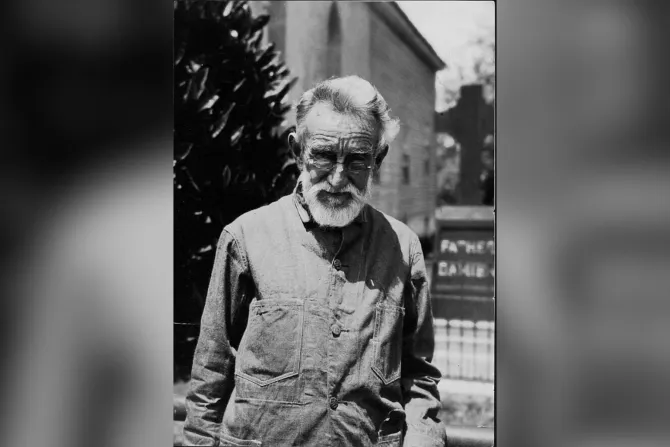
In the Diocese of Honolulu, Hawaii, the local phase concluded Sunday for the cause of canonization of Servant of God Joseph Dutton, a companion of St. Damien of Molokai and layman who lived among and served those suffering with leprosy.
Evidence from the local phase, which included 2,000 pages of investigation, will now be sent to the Dicastery for the Causes of Saints in Rome for review.
During a Mass on Sunday in celebration of the next phase toward Dutton’s potential canonization, Honolulu Bishop Larry Silva said that Dutton “exiled himself” to the remote part of Molokai island where lepers were forcibly segregated “so that he could do penance for his own wayward life.”
Dutton, a Civil War veteran for the Union out of Wisconsin, was married after the war but pursued a divorce after his wife was unfaithful and left him after one year.
Following the divorce, Dutton descended into what he called his “degenerate decade,” much of which is unknown, except for his severe drinking problem, according to the Joseph Dutton Guild, a group dedicated to his cause for canonization.
It wasn’t until about five years after he was officially divorced from his wife in 1881 that he began total abstinence from alcohol.
Silva said that Dutton went to the remote part of the island with those suffering from leprosy, now known as Hansen’s disease, “so that he could change course completely from thinking about himself and his own needs to unselfish service of others in extreme need.”
“For 44 years, he, who could have decided to leave at any time, stayed to minister to the most vulnerable, so that they would change course from a path of desperation and despair to a path of hope and joy,” Silva said. “His simple service would announce to many the gospel of liberation and freedom, even as they remained confined.”
Silva said that Dutton “left everything behind, so that he could not only change course himself but change the course of many others, by catching them from drowning in despair and raising them to the light that is Jesus Christ.”
“So it is that we — sinners and saints alike — are always called to repentance. And we pray that this wonderful man may inspire us to the freedom that only Jesus can give,” he said.
At the Mass on Sunday, three diocesan officials in charge of the local investigation swore an oath that the inquiry was done in good faith and that the findings are authentic, according to the Joseph Dutton Guild Facebook page.
Dutton was born Ira Dutton to Protestant parents in Stowe, Vermont, on April 27, 1843.
After he stopped drinking, he began studying Catholicism and officially became Catholic in Memphis, Tennessee, in 1883 when he turned 40. Dutton took on Joseph as his baptismal name.
The next year he entered a Trappist monastery in Kentucky, where he stayed for almost two years but discerned that a better way for him to offer penance would be through an active spiritual life.
Dutton subsequently discovered the work of Father Damien De Veuster (St. Damien of Molokai) on the island of Molokai; De Veuster had for years worked there with those suffering from Hansen’s disease. After learning of the saint’s work, Dutton traveled to Hawaii to serve the sick.
He became an expert in caring for the sick and continued his work after Damien died in 1889 from leprosy. Dutton himself inherited responsibility of an orphanage for boys and young men in 1895 and served there for the following 35 years.
He died in 1931 at the age of 87 at St. Francis Hospital in Honolulu.
This story was formerly published on CNA.