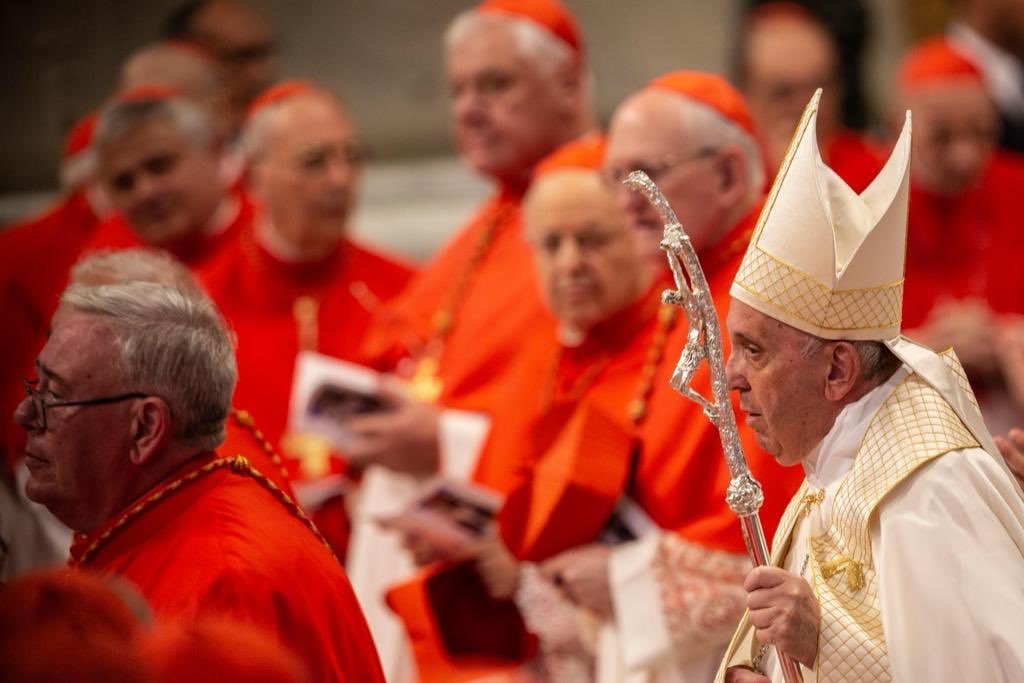
Pope Leo XIV has issued a fresh warning about the negative effects that artificial intelligence (AI) can have on the “intellectual and neurological development” of rising generations, along with a call to confront the “loss of the sense of the human” that societies are experiencing.
FIND THE POPE’S BIOGRAPHY HERE
“All of us, I am sure, are concerned for children and young people, and the possible consequences of the use of AI on their intellectual and neurological development,” the Holy Father said in a Friday message to participants at the second annual Conference on Artificial Intelligence, Ethics, and Corporate Governance, held June 19–20 in Rome.
“Our youth must be helped, and not hindered, in their journey toward maturity and true responsibility,” he indicated. He continued that young people are the “hope for the future” and that the well-being of society “depends upon their being given the ability to develop their God-given gifts and capabilities.”
Thus, according to the message made public by the Vatican Press Office, the Holy Father assured that while never before has a generation had “such quick access to the amount of information now available through AI,” this should not be confused with the ability to understand the workings of the world.
“Access to data — however extensive — must not be confused with intelligence,” he said. He added: “Authentic wisdom has more to do with recognizing the true meaning of life than with the availability of data.”
Similarly, he warned that AI can also be misused “for selfish gain at the expense of others, or worse, to foment conflict and aggression.”
At the beginning of his message, written in English, the pontiff stressed the “urgent need” for “serious reflection and ongoing discussion on the inherently ethical dimension of AI as well as its responsible governance.”
Leo XIV was particularly pleased that the second day of this meeting took place in the Apostolic Palace and assured that it was “a clear indication of the Church’s desire to participate in these discussions.”
The pontiff echoed the words of his predecessor, Pope Francis, in recalling that, despite being “an exceptional product of human genius, AI is above all else a tool.” Therefore, “tools point to the human intelligence that crafted them and draw much of their ethical force from the intentions of the individuals that wield them,” he underscored.
Pope Leo went on to point out that, in many cases, AI has been used “in positive and indeed noble ways to promote greater equality.” For example, in the uses it has been put to in the field of health research and scientific discovery.
The Holy Father stressed that the evaluation of the benefits or risks of AI must be made “in light of the “integral development of the human person and society,” as noted in the recent Vatican document Antiqua et Nova.
“This entails taking into account the well-being of the human person not only materially but also intellectually and spiritually; it means safeguarding the inviolable dignity of each human person and respecting the cultural and spiritual riches and diversity of the world’s peoples,” Leo insisted.
In the face of enthusiasm for technological innovations, the pope warned against a loss of sensitivity to the human. “As the late Pope Francis pointed out, our societies today are experiencing a certain ‘loss, or at least an eclipse, of the sense of what is human,’” he recalled.
In this regard, Leo made clear the role of the Catholic Church in weighing the ramifications of AI in light of the “integral development of the human person and society.”
Leo XIV also expressed his hope that the meeting’s deliberations would include reflection on intergenerational roles in ethical formation. “I express my hope that your deliberations will also consider AI within the context of the necessary intergenerational apprenticeship that will enable young people to integrate truth into their moral and spiritual life,” he concluded.
SIGN UP FOR OUR NEWSLETTER HERE
This story was first published by ACI Prensa, CNA’s Spanish-language news partner. It has been translated and adapted by CNA.