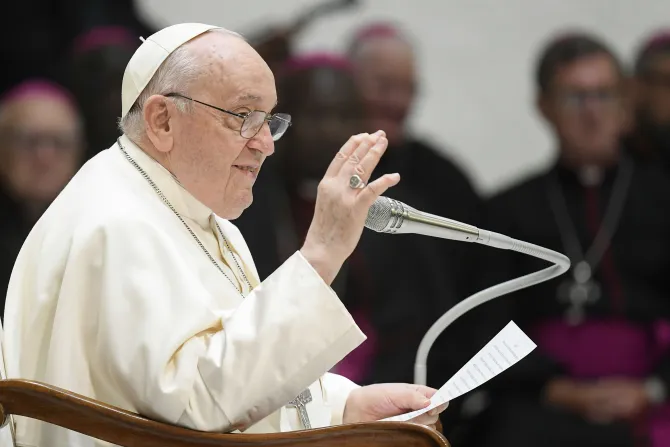
Pope Francis continued his general audience catechetical series on vice and virtues on Wednesday by focusing on sorrow, observing that it can be “understood as a despondency of the soul, a constant affliction that prevents man from feeling joy at his own existence.”
During the Feb. 7 audience the pope observed that sorrow can assume a sinister and destructive form and could be understood as an “ailment of the soul” that “creeps into the soul and prostrates it in a state of despondency” and “must be fought resolutely.”
Sorrow can be particularly difficult for man to deal with as it “is linked to the experience of loss” and consequently “arises in the human heart when a desire or hope vanishes,” the Holy Father said to the faithful gathered in the Paul VI Audience Hall.
“In the heart of man, hopes arise that are sometimes dashed. It can be the desire to possess something that instead we are unable to obtain, but it can also be something important, such as an emotional loss,” the pope said. “When this happens, it is as if man’s heart falls from a precipice, and the sentiments he feels are discouragement, weakness of the spirit, depression, and anguish.”
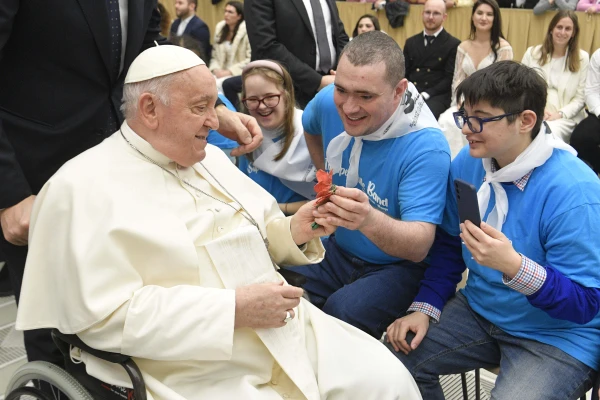
Reflecting on the universality of this second type of sorrow as an experience that is inherent to the human condition, the pope observed that “we all go through ordeals that generate sorrow in us, because life makes us conceive dreams that are then shattered.”
The pope contrasted the different ways we can react to these tumultuous and jarring situations by saying that some people “rely on hope” while “others wallow in melancholy, allowing it to fester in their hearts.”
“Sadness is the pleasure of non-pleasure,” the pontiff emphasized.
The pope cautioned the faithful to be vigilant, highlighting the destructive and isolating conditions that often come about by being caught in “certain protracted griefs,” as it is in this state that “a person continues to expand the void of one who is no longer there.”
“Certain resentful bitterness, where a person always has a claim in mind that makes them take on the guise of the victim, does not produce a healthy life in us, let alone a Christian one,” the pope said. “There is something in everyone’s past that needs to be healed. Sorrow, from being a natural emotion, can turn into an evil state of mind. It is a devious demon, that of sorrow.”
However, the pope juxtaposed this form of sorrow — which lends itself to self-destructive habits and an estrangement from God — with an “appropriate” form of sorrow or, as the pontiff called it, “friendly sorrow” that can aid Christians in their spiritual life and development.
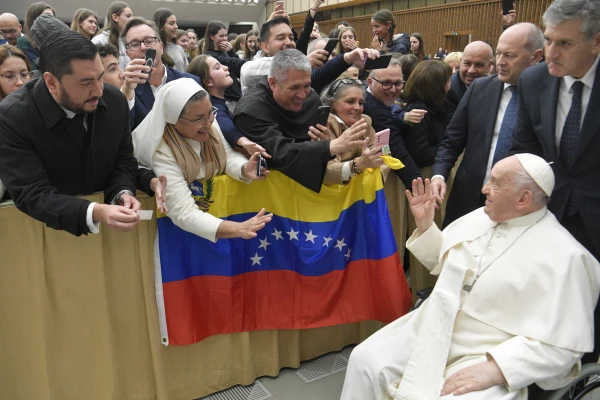
Recalling that this distinction was drawn by the Church fathers, Pope Francis noted that this latter form of sorrow can “with God’s grace can be changed into joy” and implored the faithful to remember that it “must not be rejected” as it is an essential “part of the path of conversion.”
To provide an example of this transformative “friendly” sorrow, the pope referenced the parable of the prodigal son from the Gospel of Luke. In this biblical story, a son asks his father for his inheritance but shortly thereafter squanders all of his money and finds himself in a state of destitution and despondency. Finding himself isolated and after working in horrid conditions, the younger son comes back to his father, with a contrite heart, to seek forgiveness — and he is joyfully welcomed back.
Against the backdrop of this story, the pope said: “It is a grace to lament over one’s own sins, to remember the state of grace from which we have fallen, to weep because we have lost the purity in which God dreamed of us.”
At the end of the general audience the Holy Father expressed his closeness to “the young people, the sick, the elderly, and the newlyweds” and called upon the “maternal tenderness” of Our Lady of Lourdes, whom the Catholic Church celebrates on Sunday, Feb. 11.