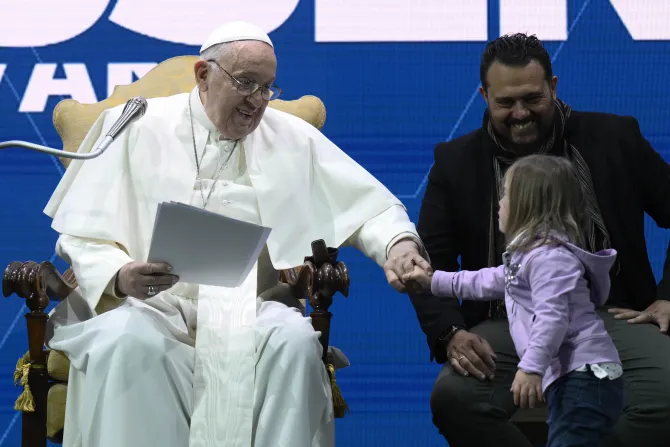
When Pope Francis took to the stage on Friday to speak at a conference on the state of birth rates in Italy and the wider West, he did not equivocate.
“The problem of our world is not the children that are born — it is selfishness, consumerism, and individualism, which make people full, lonely, and unhappy,” the pope said to the audience gathered in the Auditorium della Conciliazione in Rome.
This year’s edition of “Stati Generali della Natalità,” or “General State of the Birth Rate,” is based on the theme “More Young People, More Future.” It is the fourth edition of the gathering, which was launched back in 2021 as a joint project with then-Italian premier Mario Draghi and Gigi De Palo, the president of the Forum of Family Associations.
Italy, like many countries in Western Europe, has been facing an acute demographic crisis in recent years. Births in Italy dropped to a historic low in 2023. Italy’s national statistics bureau recorded 379,000 births last year, a 3.6% decline from 2022 and a 34.2% drop from 2008.
Arriving shortly after 9 a.m., Pope Francis took his seat at center stage, flanked by sitting children on both sides, and delivered a speech that, while cautionary and at times striking a dire tone, was also rooted in hope, with the Holy Father arguing that it is “important to meet and work together to promote birth rates with realism, foresight, and courage.”
“The number of births is the first indicator of a people’s hope. Without children and young people, a country loses its desire for the future,” the pope said.
“Unfortunately,” the pope continued, “if we were to rely on this data, we would be forced to say that Italy is progressively losing its hope for the future, like the rest of Europe.”
“The Old Continent is increasingly transforming into an old, tired, and resigned continent, so committed to exorcizing loneliness and anxieties that it is no longer able to enjoy, in the civilization of the gift, the true beauty of life,” Francis continued.
The Holy Father sharply rebuked population alarmism pushed by some theories such as Malthusianism, which posits that unchecked birth rates will quickly exhaust agricultural resources, leading to famine and war. The pope called those theories “long out of date.”
Striking a very different tone, he said: “Human life is not a problem, it is a gift.”
The pope did touch upon the effects of climate change, suggesting that it is not the effect of population growth but rather a consequence of prevailing economic models and consumer attitudes, or “rampant materialism,” which “attacks the existence of people and society at the root.”
“The problem is not how many there are in the world but what world we are building,” Francis added. “It is not children, but selfishness, which creates injustices and structures of sin, to the point of intertwining unhealthy interdependencies between social, economic, and political systems.”
The pope also appealed for change on an institutional level, imploring governments to spearhead pro-family initiatives so that mothers are not in the position “to choose between work and caring for her children” and so younger couples are not faced with “the burden of job insecurity and the inability to buy a house.”
In line with this broader reflection of the importance of the family, Pope Francis underscored the importance of valuing the elderly, calling the ostracization of the elderly “cultural suicide.”
“The future is made by the young and the old together, courage and memory, together,” the pontiff continued.
Despite the exigent demands to reverse the negative trends, the pope ended his speech striking a more optimistic tone, encouraging young people to not “give up” and to “have faith.”
“I know that for many of you the future may appear disturbing, and that between birth rates, wars, pandemics, and climate change it is not easy to keep hope alive. But don’t give up, have faith, because tomorrow is not something inevitable: We build it together, and in this ‘together’ first of all we find the Lord.”
This article was originally published on Catholic News Agency.