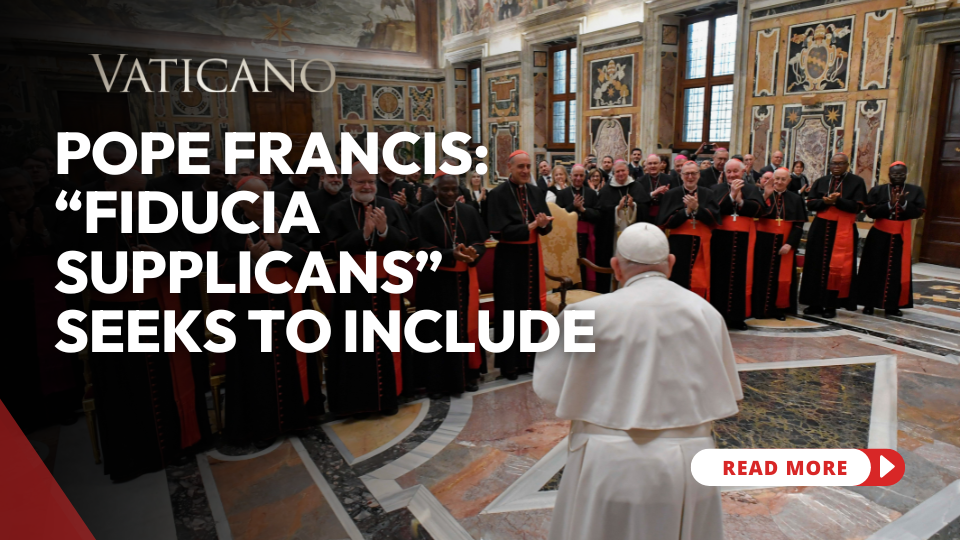
In a long interview with the Italian newspaper “La Stampa,” Pope Francis once again repeated his thoughts on Fiducia supplicans, the Declaration on Blessings published on December 18.
The pontiff explained how criticism of the document comes from “small ideological groups,” adding that Africans are “a case apart,” since “for them homosexuality is something ‘ugly’ from the cultural point of view; they do not tolerate it.”
The pope also stressed that his hope is “that gradually everyone will be reassured about the spirit of the declaration,” which, “wants to include and not divide, because it calls for welcoming, and then entrusting people to God.”
Thoughts the pontiff had already shared on Friday, January 26th, while meeting with the Dicastery for the Doctrine of the Faith at the Vatican.
The Pope clarified, “These blessings, outside of any liturgical context and form, do not demand moral perfection in order to be received; the second, that when a couple approaches spontaneously to ask for them, one does not bless the union, but simply the people who have required it together. Not the union, but the people.”
Along with almost the entire African continent, the Slovakian Bishops’ Conference, the Hungarian Bishops’ Conference, the Ukrainian Greek Catholic Church, and the Dutch bishops have also voiced criticism of the document. In fact, the Dutch bishops’ conference stood in stark contrast to the Belgian conference, which instead, back in 2022, had authorized blessings to any kind of couple.
At the same time, opposition from individual prominent cardinals is also growing. After Cardinal Gerhard Müller and Cardinal Robert Sarah, Cardinal Joseph Zen has voiced his opinion, one of the five signatures of the recent dubia addressed to Pope Francis.
On Monday morning, the Holy Father met again with Cardinal Víctor Manuel Fernández, Prefect of the Dicastery for the Doctrine of the Faith. A new document on human dignity is expected but also some further comments on Fiducia Supplicans, a topic that will surely be discussed next October with the second part of the Synod on Synodality.
Adapted by Jacob Stein