Pope Francis decried how “the unborn with disabilities are aborted” in a speech on Thursday to a Vatican conference on disability inclusion.
The pope warned that “the throwaway culture” turns into “a culture of death” when people “presume to be able to establish, on the basis of utilitarian and functional criteria, when a life has value and is worth being lived.”
He pointed out that we see this today especially on the two extremes of the spectrum of life — “the unborn with disabilities are aborted and the elderly close to the end are administered an ‘easy death’ by euthanasia.”
According to the University of Notre Dame’s McGrath Institute for Church Life, it’s estimated that there are as many as 27,000 abortions annually due to a poor prenatal diagnosis in the United States.
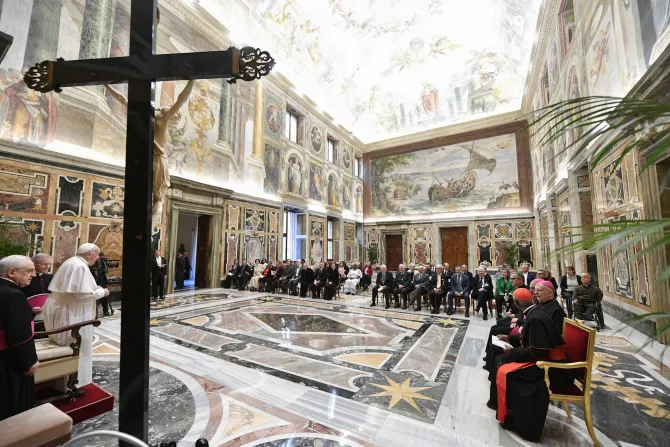
“Every human being has the right to live with dignity and to develop integrally. Even if they are unproductive, or were born with or develop limitations, this does not detract from their great dignity as human persons, a dignity based not on circumstances but on the intrinsic worth of their being,” Pope Francis said in the Apostolic Palace’s Clementine Hall on April 11.
The pope addressed this message to the Pontifical Academy of Social Sciences, which is made up of academics and professionals in the fields of law, political science, economics, and sociology.
The academy is meeting at the Vatican this week for its plenary session on disability inclusion.
“The plenary intends to take up the challenge and make its own contribution by identifying what … represent the barriers that increase the disability of a society and prevent persons with disability from fully participating in social life,” the plenary session’s program says.
The three-day conference includes discussions on the rights of persons with disabilities, policies for greater economic inclusion, and philosophical perspectives on disability and the human condition.
In his speech to the pontifical academy, Pope Francis underlined that “vulnerability and frailty are part of the human condition and not something proper only to persons with disabilities.”
He said that “combating the throwaway culture calls for promoting the culture of inclusion” by “forging and consolidating the bonds of belonging within society.”
The pope added that “the bonds of belonging become even stronger when persons with disabilities are not simply passive receivers but take an active part in the life of society as agents of change.”
According to the Pontifical Academy for Social Sciences, there is no exact number for the amount of people with disabilities worldwide, but international organizations estimate that 16% of the world’s population experience significant disabling conditions.
The “First World Report on Disability” found that people with some form of physical, sensory, or intellectual impairment experience multiple disadvantages compared with the rest of the population, which include barriers in accessing services, lower levels of education, poverty, and less participation in political and cultural life.
“Sadly, in various parts of the world, many persons and families continue to be isolated and forced to the margins of social life because of disabilities,” Pope Francis said.
“And this not only in poorer countries, where the majority of disabled persons live and where their condition often condemns them to extreme poverty, but also in situations of greater prosperity, where, at times, handicaps are considered a ‘personal tragedy’ and the disabled ‘hidden exiles,’ treated as foreigners in society.”
In the pontifical academy’s concept note for the plenary session, the academy recognized the strong solidarity found in family associations that support and accompany families who care for disabled individuals, noting that this solidarity takes on a social significance.
Pope Francis highlighted that “the Church’s care and concern for those with one or more disabilities concretely reflects the many encounters of Jesus with such persons, as described in the Gospels.”
“Jesus not only relates to disabled persons; he also changes the meaning of their experience,” he said. “In fact, he showed a new approach to the condition of persons with disabilities, both in society and before God.”
“In Jesus’ eyes, every human condition, including those marked by grave limitations, is an invitation to a unique relationship with God that enables people to flourish.”