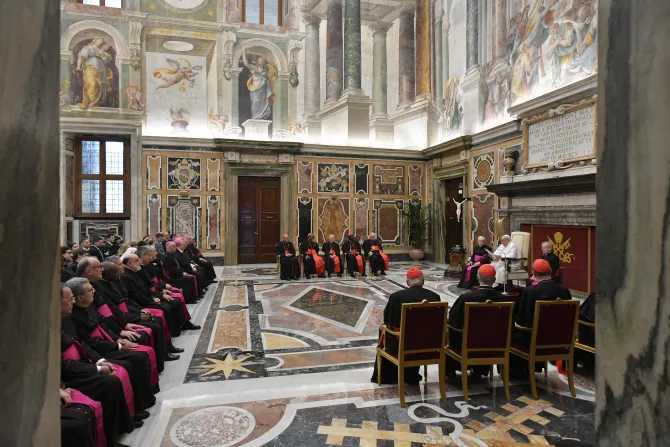
Pope Francis has appointed two cardinals and an archbishop as new members of the Dicastery for the Doctrine of the Faith.
The new appointments come as the Vatican office continues to grapple with the ecumenical fallout from Fiducia Supplicans, the dicastery’s declaration permitting nonliturgical same-sex blessings for same-sex couples.
Cardinal Víctor Manuel Fernández, who has led the dicastery since September 2023, recently traveled to Egypt in an attempt to ease tensions after the Coptic Orthodox Church suspended its dialogue with the Catholic Church amid concerns over the blessings declaration.
Here is a look at the new members of the dicastery, which oversees matters of doctrinal orthodoxy throughout the global Catholic Church as well as the investigation and processing of sex abuse allegations against clergy.
Cardinal José Tolentino de Mendonça
Cardinal José Tolentino de Mendonça is the head of the Vatican Dicastery for Culture and Education. The 58-year-old cardinal, originally from the Portuguese island of Madeira, is an expert in the relationship between literature and theology, according to the Vatican. He has published poetry as well as academic theological articles. He was the archivist and librarian of the Holy Roman Church from 2018 to 2022.
Before coming to Rome, Mendonça was a professor in Portugal and Brazil and spent one year at the Straus Institute for the Advanced Study of Law and Justice at New York University.
Mendonça also served as the rector of the Capela do Rato, a private chapel in Lisbon known prior to the cardinal’s arrival for its ministry with people with same-sex attractions.
When asked about this ministry in an interview in 2015, he replied: “I don’t choose the people with whom I have to walk. Since I don’t choose, I don’t judge. The attitude of the Church has to be one of welcome, of a normal accompaniment of what people live and are.”
Mendonça wrote a preface to a book on feminist theology by Sister Maria Teresa Forcades i Vila, a Benedictine sister who has advocated for a theological case for abortion rights that is “compatible with the Gospel,” which praised the sister for “courageously pointing out contradictions and looking for alternatives of interpretation that support a break in meaning and civilization.”
The Benedictine sister also spoke at Mendonça’s book launch in 2016, the same year that the sister published her book “We Are All Diverse! In Favor of a Queer Theology.”
Pope Francis chose Mendonça to preach the Lenten spiritual exercises for the Roman Curia in 2018 and made him a cardinal in 2019. He has been a member of the Third Order of St. Dominic since 2020.
“Whether remarried Christians, those wounded by the experience of marital breakdown, or the reality of new [irregular] families, or homosexual people, the Church must find a space for listening,” Mendonça said in 2016.
Cardinal Marcello Semeraro
Cardinal Marcello Semeraro is the prefect of the Vatican Dicastery for the Causes of Saints. The 76-year-old cardinal from southern Italy previously served as bishop of Albano, a suburbicarian diocese located about 10 miles from Rome. He holds a doctorate in theology from the Pontifical Lateran University.
Prior to being made a cardinal in 2020, Semeraro acted as the secretary for Pope Francis’ council of cardinal advisers for seven years.
Semeraro wrote the preface to Father Aristide Fumagalli’s book “Possible Love: Homosexual Persons and Christian Morality” in 2020.
In an interview with Corriere della Sera in 2016, Semeraro said that he had “no objection” to the legal recognition of civil same-sex unions as long as they “were not equated with the reality of marriage.”
The cardinal has also spoken publicly about his views on divorce and remarriage, telling the Quotidiano di Puglia in 2018: “I say that if divorced people want to remarry this is even a good thing: It means that they have not lost faith in marriage. And today the Church is very attentive to the subjective aspect of the issues, so it must be evaluated on a case-by-case basis. Times change. … The parent who always punishes is as ineffective as the parent who never punishes.”
Archbishop Bruno Forte
Archbishop Bruno Forte is a theologian who has served as the archbishop of Chieti-Vasto on Italy’s eastern coast since 2004. The 74-year-old archbishop is the author of numerous publications on theology, philosophy, and spirituality.
John Paul II asked him to preach the spiritual exercises at the Roman Curia’s Lenten retreat in 2004 after Forte helped to oversee the preparation of the Vatican document “Memory and Reconciliation: The Church and the Faults of the Past,” which preceded Pope John Paul II’s apology for historical sins by the Church in 2000.
Forte was also responsible for sections on homosexuality in the interim document for the first session of the Synod on the Family in 2014, according to National Catholic Register correspondent Edward Pentin, who wrote a book about the synod.
“The Church does not believe that the term ‘family’ can be used to refer both to a union between a man and a woman that is open to procreation and a same-sex union. Having said this, it seems obvious to me that humans have different experiences and have rights that must all be protected. The issue here, therefore, is not equating the two in all senses, including in terminological terms,” Forte said during the synod in 2014, according to La Stampa.
“Naturally, this does not mean that we should rule out looking for a way to describe the rights of people living in same-sex unions. It is a question — I think — of being civilized and respecting people’s dignity.”
In 2023, Forte made headlines when he issued a statement on a local gay pride event, saying: “We pray that anyone involved in the event … will check their conscience on the goodness of their choices and, if they are believers, do so before God, with a sense of responsibility toward the entire ecclesial and civil community.”
This article was originally published on Catholic News Agency.