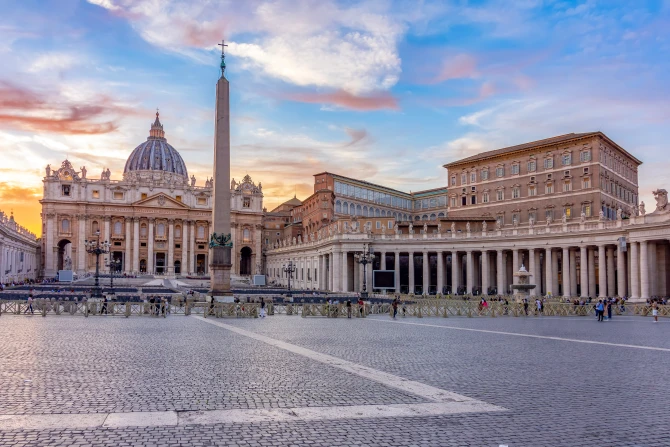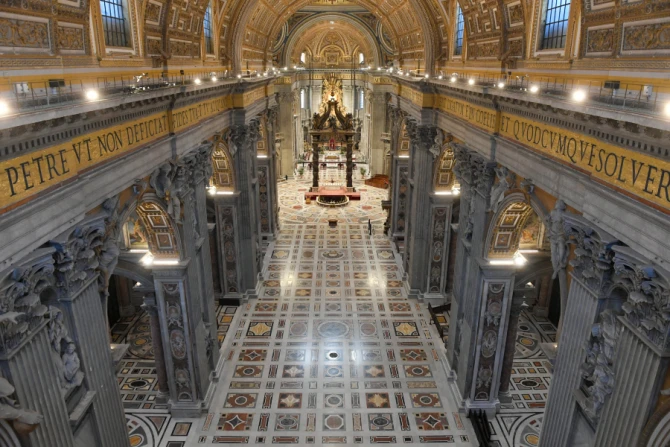
Microsoft President Brad Smith is set to unveil an artificial intelligence-enhanced project focusing on St. Peter’s Basilica during a press conference at the Vatican on Nov. 11.
This initiative, titled “The Basilica of St. Peter’s: AI-Enhanced Experience,” is a collaboration between Microsoft and the Fabric of St. Peter, the organization responsible for the conservation and maintenance of St. Peter’s Basilica.
Since Smith launched Microsoft’s AI for Cultural Heritage program in 2019, the tech company has worked on a number of projects that provided digitally enriched ways to explore art, architecture, and historical sites through artificial intelligence.
Microsoft developed the Ancient Olympia project in Greece, which used AI to digitally reconstruct the birthplace of the Olympic Games, offering an immersive exploration of the ruins.
Similarly, Microsoft partnered with Iconem to create digital models of Mont-Saint-Michel in France using AI and 3D modeling to capture the intricate details of the 1,000-year-old Catholic pilgrimage site.
Other companies have also provided virtual reality experiences of historically significant churches in past years, including a 3D immersive exhibition of the Church of the Holy Sepulchre called the “Tomb of Christ” in the National Geographic Museum in Washington, D.C.
Microsoft CEO Satya Nadella recently spoke in Rome on Oct. 23 after the company announced a 4.3 billion euro (about $4.64 billion) investment in Italy over the next two years to expand its hyperscale cloud data center and artificial intelligence infrastructure, which will make the Italian cloud region one of Microsoft’s largest data center regions in Europe and a strategic hub in the spread of AI innovation in the Mediterranean.
Microsoft also announced a collaboration with the municipality of Rome to develop “Julia,” an AI-based virtual assistant that will help the over 35 million visitors expected in the Italian capital for the upcoming 2025 Jubilee Year.
Jubilee pilgrims will be able to ask Julia, a virtual city guide, questions via WhatsApp about cultural heritage sites as well as suggestions for accommodations and restaurants to taste typical Roman and Italian cuisine.
The Vatican and AI ethics
The St. Peter’s Basilica project will not be the first time that the Vatican has partnered with Microsoft on matters of artificial intelligence.
Years before the widely popular release of the GPT-4 chatbot system, developed by the San Francisco startup OpenAI, the Vatican was already heavily involved in the conversation of artificial intelligence ethics, hosting multiple high-level discussions with scientists and tech executives on the ethics of artificial intelligence since 2016.
In February 2020, Smith took part in a Vatican event called “renAIssance: For a Humanistic Artificial Intelligence,” where he signed the Vatican’s artificial intelligence ethics pledge, the Rome Call for AI Ethics, along with IBM Executive Vice President John Kelly III.
Since then the pope has hosted other tech leaders, including Chief Executive of Cisco Systems Chuck Robbins, who also signed the Vatican’s artificial intelligence ethics pledge, in April in Rome.
The Rome Call, a document by the Pontifical Academy for Life, underlines the need for the ethical use of AI according to the principles of transparency, inclusion, accountability, impartiality, reliability, security, and privacy.
Pope Francis chose artificial intelligence as the theme of his 2024 peace message, which recommended that global leaders adopt an international treaty to regulate the development and use of AI. Francis became the first pope to address the G7 summit in June when he was invited to speak to world leaders about AI ethics.
In July, Father Paolo Benanti, a member of the United Nations’ advisory body on AI and adviser to Pope Francis on ethics and technology, visited the Microsoft headquarters in Washington to speak with Smith.
In an interview with GeekWire following the Vatican’s AI conference in 2023, Smith reflected on how having religious leaders in the room at a technology conference “adds an extraordinary dimension to the conversation.”
“You can ask whether this was having religious leaders in a technology meeting or technology leaders in religious conversation; both are true. … It forces one to think about and talk about the need to put humanity at the center of everything we do,” Smith said.
This article was originally published on Catholic News Agency.