Rome, Italy — Santa Maria dell’Orazione e Morte, or St. Mary of Prayer and Death, is an 18th-century confraternity church in Rome on Via Giulia next to Campo de’ Fiori and Palazzo Farnese, situated near the bank of the Tiber River. The dedication of the church is to the Blessed Virgin Mary, under the particular title of “Our Lady of Prayer and Death.”
The church was established in 1576 to provide a proper burial for abandoned corpses. It initially contained massive vaults where over 8,000 bodies were buried; most of the vaults, however, were destroyed during later construction in 1886.
The origins of the church lie with a confraternity founded in 1538, a confraternity associated with the Basilica of San Lorenzo in Damaso. The Compagnia della Morte, or “Company of Prayer and Death,” was an informal association of laypeople who were concerned with a situation where abandoned bodies were being found in the countryside of Rome and the Tiber River. The bodies were not receiving proper burial, and poor country dwellers were dumping their dead rather than taking them into the city for a proper funeral.
The association received a charter as a pious confraternity from Pope Julius III in 1552. In this, the pope made it clear that the new Confraternity had the task not just of burying bodies but of praying for the souls of these departed.
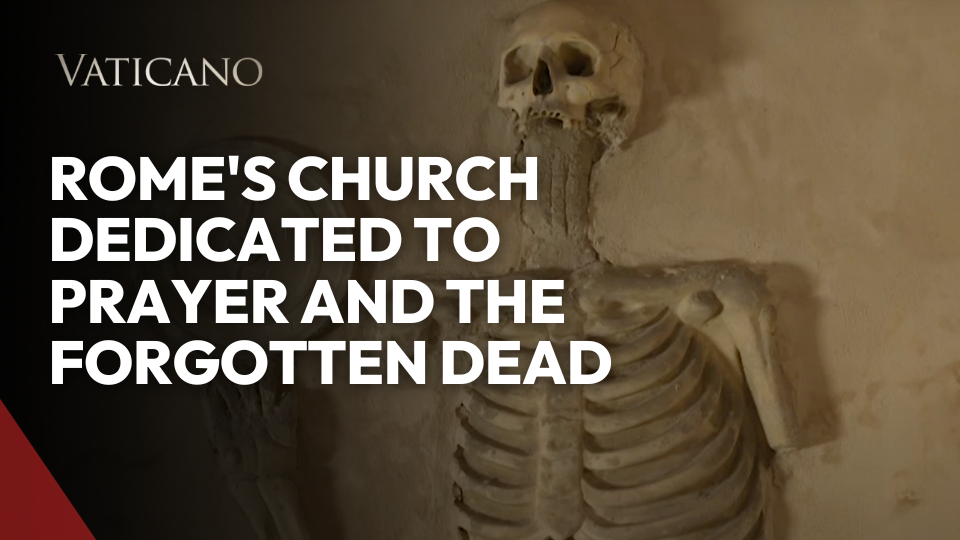
The small church proved inadequate in the 17th century, as did the attached cemetery. So, a project of complete rebuilding began in 1732. The architect was Ferdinando Fuga. Famously, he embellished the exterior with skulls. There are skeletons set in the wall, etched skulls stacked on shelves, and bones piled by the altar and made into a cross. Even the chandeliers are made with human vertebrates. Ominously, a scythe lurks near the altar.
The new layout included a cemetery along the riverbank. The original cemetery of the Confraternity remained in operation until the 19th century. The Confraternity and its records show that it buried about 8,600 bodies between 1552 and 1896. This amounted to about 25 per year.
As we traverse this month of November, let us take the Church of St. Mary of Prayer and Death as an example to ponder our mortality and remember to pray for the dead.
[Adapted by Jacob Stein]