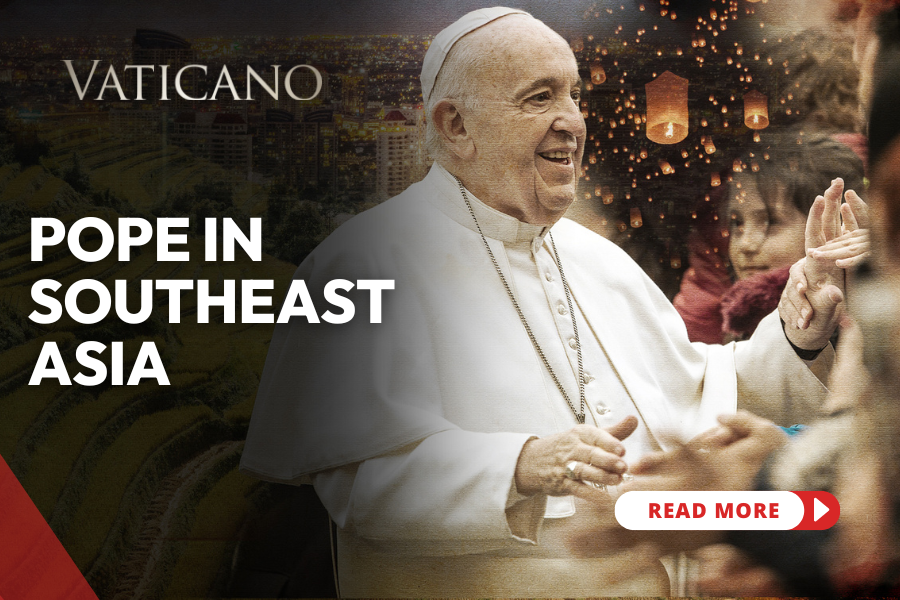
Pope Francis’s upcoming visit to Indonesia, Papua New Guinea, Timor Leste, and Singapore marks a pivotal moment for the Catholic Church in Southeast Asia, where religious coexistence and social challenges intersect.
The Pope’s first stop: Indonesia
Indonesia, with its 29 million Christians amidst 242 million Muslims, stands as a beacon of religious harmony. The Pope’s visit, the first to Indonesia since Pope St. John Paul II’s visit in 1989, aims to strengthen ties between Christians and Muslims in a country where Catholics make up just 3% of the population.
In Jakarta, Father Thomas Ismoyo reflects on the significance of this visit, emphasizing the peaceful coexistence between Catholics and the Muslim majority. Indonesia’s approach to religious harmony is exemplified by the Cathedral in Jakarta, located directly opposite the Istiqlal Mosque.
This proximity, a deliberate decision by Indonesia’s first president, symbolizes interfaith unity. Today, the “Tunnel of Tolerance,” a physical link between the Cathedral and the mosque, stands as a testament to ongoing efforts in religious dialogue. The Pope’s planned meeting with Grand Imam Nasaruddin Umar through this tunnel will further reinforce these ties.
Harmony mixed with challenges
However, alongside this religious harmony, Indonesia grapples with significant social issues, particularly poverty and corruption. Despite being a deeply religious country, corruption is pervasive, deepening the divide between the rich and the poor.
Father Ismoyo acknowledges the challenge of living in a society where religious values clash with widespread corruption. Yohanes “Yos” Bastian, a Catholic author and former government official, points out that corruption is often seen as necessary to expedite government processes. Both men stress the ongoing struggle to change this entrenched culture.
For Indonesian Catholics, Pope Francis’s visit is more than a diplomatic mission—it’s a beacon of hope.
Traveling to Papua New Guinea
After his time in Indonesia, the Pope will journey to Papua New Guinea, a nation known for its rich cultural heritage but also for significant social challenges. Father Lawrence Iro Kuraj, who has served in Papua New Guinea for 25 years, highlights the deep faith of local Catholics despite divisions among Christian denominations and the challenges of uniting a linguistically diverse population.
Cardinal John Ribat, the Archbishop of Port Moresby, discusses the strong sense of community in Papua New Guinea, a quality that is both a strength and a challenge. Tribal affiliations and the practice of payback often lead to violence, but the Church’s efforts to promote forgiveness are slowly making progress.
Gender-based violence is another pressing issue, with high rates of abuse, especially against women accused of sorcery. Father Gerard Mulumba, who runs a shelter for survivors, notes the immense challenges these women face. Sister Barbara, a missionary nun, works to combat violence rooted in sorcery accusations, stressing the importance of education in changing deeply ingrained mindsets.
The challenges in Papua New Guinea are numerous, from extreme poverty to a lack of basic services. The Catholic Church plays a crucial role in addressing these issues, but resources are limited. Pope Francis’s visit will bring much-needed attention to these problems, particularly the plight of women and children.
The Pope’s presence
This journey by Pope Francis to Southeast Asia underscores the Catholic Church’s commitment to social justice, peace, and interfaith dialogue. His visit is not just about strengthening the faith but about advocating for the marginalized and fostering unity.
Despite his age and health challenges, the Pope’s presence in these countries highlights the Church’s role in promoting a more just and compassionate world. The impact of his visit will resonate long after he leaves, inspiring continued efforts toward tolerance, justice, and peace in the region.
As the Pope prepares to embark on this significant journey, the eyes of the world will be on Indonesia and Papua New Guinea. The lessons learned and the seeds of change sown during this visit will likely influence the region’s social and religious landscape for years to come.
Adapted by Jacob Stein