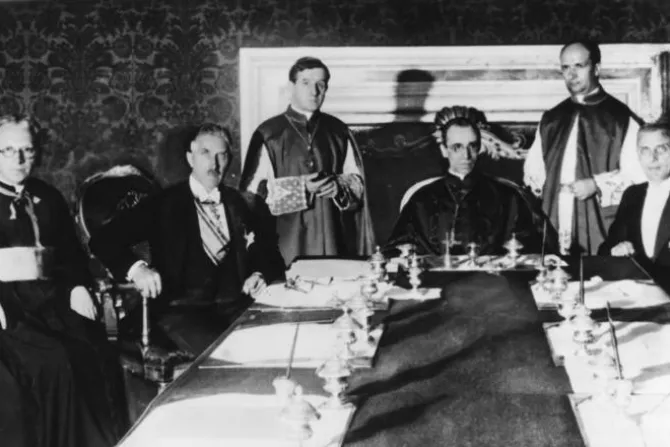
On Thursday, July 20, the Catholic Church marks the 90th anniversary of a deal made in Rome on a hot summer day in 1933 between Hitler’s Germany and the Holy See: the Reichskonkordat. It’s a treaty that is both historically significant and relevant today because it has never been abrogated.
Archbishop Nikola Eterovic, the apostolic nuncio to Germany, addressed the Reichskonkordat anniversary in a speech delivered in Berlin last month, reported CNA Deutsch, CNA’s German-language news partner.
The nuncio strongly defended the treaty while acknowledging its complex history: “The Holy See looks back on the existence of this concordat with satisfaction today, even though its origin fell into the early era of the Nazification (Gleichschaltung) of cultural, social, and political life in Germany.”
The Reichskonkordat — like all concordats — governs relations between the Catholic Church and other states, in this case, Germany. Its 34 articles confirm the recognition of the Catholic religion, the freedom of ecclesiastical administration, the protection of religious orders and congregations, the regulation of sacramental marriage, and the guarantee of Catholic religious practice and education.
Despite the agreement, the Nazis did not refrain from violating the treaty and persecuting the Church, its clergy, and its faithful. The Church protested against breaches of the agreement, famously so in the 1937 encyclical Mit Brennender Sorge.
Cautioning against misinterpreting the Reichskonkordat through the lens of Soviet and Nazi propaganda, Eterovic said on June 14 that the treaty was not the first foreign policy success of Adolf Hitler, or even a kind of Nazi success in Hitler’s attempts to discredit the Holy See.
Rather, the prelate said, Nazi Germany had already ratified on May 5, 1933, the extension of a 1926 treaty of friendship with the Soviet Union. Thus, the Reichskonkordat, signed on July 20, 1933, was the second foreign policy treaty of the Hitler government.
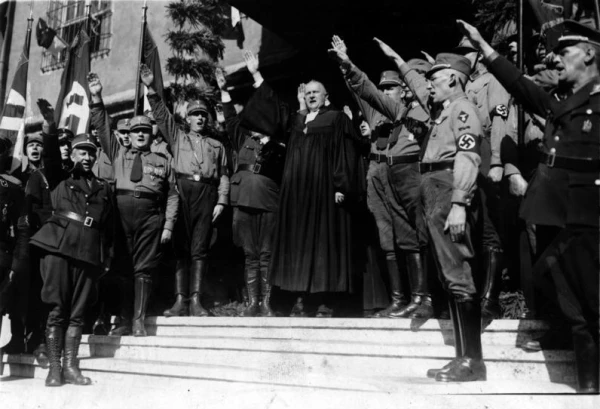
What is more, Eterovic said, the treaty “helped to guarantee Church life in Germany, even if it did not prevent the National Socialist Kirchenkampf” — the Nazis’ ideological war against Christianity in general and Catholicism in particular.
After World War II, Pope Pius XII upheld the Reichskonkordat over the objections of some German bishops and the Allied powers. The pope argued that the treaty was still valid and useful to the Church, but some historians question his motives and actions during and after the war.
The Reichskonkordat is still in force today because it has not been formally abrogated by either party. However, some of its provisions have been changed through later agreements or laws, such as the Basic Law of Germany and concordats with individual states.
Nuncio Eterovic noted: “Today, the Holy See has entered into 241 valid concordat treaties with 74 states. In the Federal Republic of Germany, the Reichskonkordat is only one of a total of 15 valid concordat treaties due to the federal structure of this state.”
Adding to the reflections on the Reichskonkordat, historian Jan Wille, in an article published July 20 on a portal financed by the German Bishops’ Conference, provided a nuanced perspective on the treaty’s legacy and potential future. Writing for katholisch.de, Wille emphasized that the Reichskonkordat was not only a contentious issue in the relationship between the German state and the Catholic Church but also a subject of intense debate among historians.
“While there is currently no legal reason for a revision, renegotiation, or dissolution of the Reichskonkordat, the current transformation of the role of the Church and the questions of the Europeanization of church-state law make it advisable to at least consider a reform of the treaty,” Wille wrote.
The Reichskonkordat’s anniversary comes at a time when the Catholic Church in Germany is grappling with significant challenges, as is the diplomacy of the Holy See.
The controversial German Synodal Way has sparked tensions and worldwide concerns over another schism from the land of Luther. Moreover, the Church is experiencing a German exodus: A massive — and accelerating — decline in membership. Scientists at the University of Freiburg predict that the number of Christians paying church tax in Germany will halve by 2060. At the same time, the Holy See is once again under scrutiny for diplomatic treaties, in particular the Vatican-China deal, while a delegate of Pope Francis on Tuesday met with U.S. President Joe Biden to discuss the war in Ukraine.
This article was originally published on Catholic News Agency.