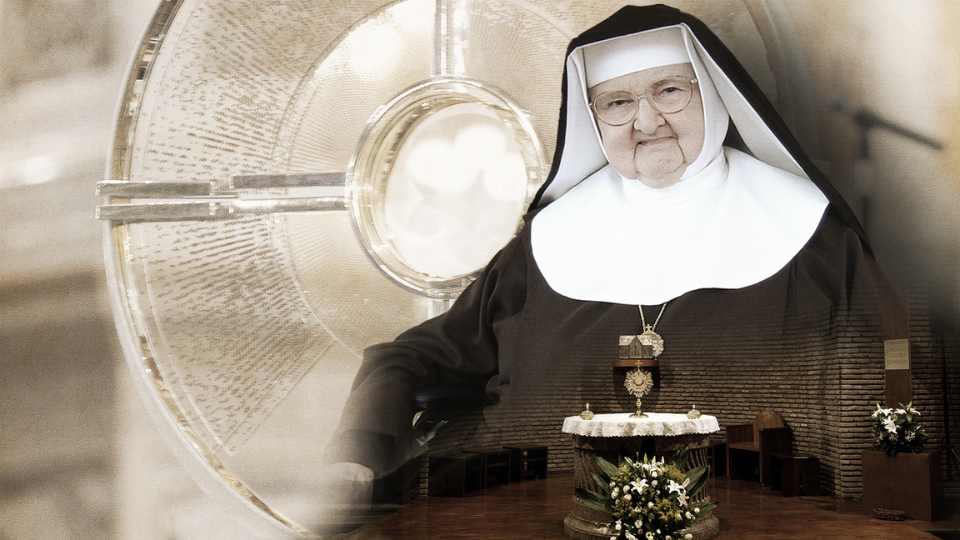
As the 53rd International Eucharistic Congress begins in Quito, Ecuador, under the theme “Fraternity to Heal the World,” EWTN’s late foundress, Mother Angelica, invites us to reflect on the mystery of the Eucharist and how it is a sacrament of unity. In one episode, she said:
“Maybe you have a doubt about the Eucharist. Maybe someone has confused you about it. Whatever it is, that’s what we are going to talk about tonight.”
The fact that the Son of God, Jesus Christ, invites us to eat His flesh and drink His blood has always disturbed people. Chapter 6 of the Gospel of John reports that many turned away from Christ after He described Himself as the “bread of life.”
Understanding the Mystery of the Eucharist
During her live show in 1994, Mother Angelica, the founder of the Catholic television network EWTN, explained why many disciples took offense at Jesus’ words.
“No way anybody could have understood! But the ones who left knew exactly what He meant,” Mother Angelica explained. “They were to eat His flesh and drink His blood, so they walked away. Peter says: ‘We know You are the holy one. And we believe.’”
The Catholic Church’s teaching on the Eucharist is deeply rooted in the words of Jesus in the Bible, and this teaching has been consistently reinforced by the Popes throughout the centuries. Pope Francis continues this tradition, offering clear and thoughtful reflections on the significance of the Eucharist.
In his recent Angelus message on August 18, 2024, Pope Francis explained, “The heavenly bread, which comes from the Father, is the Son Himself made flesh for us.” He asked, “When I receive the Eucharist, which is the miracle of mercy, do I stand in awe before the Body of the Lord, who died and rose again for us?”
The Eucharist and the Unity of the Church
The Eucharist is not only important for the personal faith of every Christian but also for the unity of the entire Church. Pope Benedict XVI emphasized this in 2011: “Because there is one bread, we who are many, are one body, for we all partake of the one bread. With the Eucharist, the Church is born.”
Pope Benedict also acknowledged that Jesus’ revelation in the Eucharist challenges His own Church. “We too find it hard,” the Pope admitted, “to accept that He bound Himself to the limitations of His Church and her ministers. We too do not want to accept that He is powerless in this world. We too find excuses when being His disciples starts becoming too costly, too dangerous. All of us need the conversion which enables us to accept Jesus in His reality as God and man.”
Reverence and Internal Disposition
In order to express reverence for Christ in the Eucharist, the Church has promoted certain forms of devotion over the centuries. Mother Angelica spoke to our gestures during Holy Mass. “How can you stand,” she asked, “when the third person, the Holy Spirit, comes down into the hands of a priest in that awesome moment, when He changes that bread into the body and the blood? How can you stand? You know, somebody told me that they stood because if they were about to see the president of the United States, they would stand. So would I! But the president of the United States, sweetheart, is not God!”
However, for Jesus Christ to truly transform a person through the Eucharist, both external gestures and internal disposition are essential. As Pope Francis emphasized, “Let us receive it with gratitude, not in a passive, habitual way. We should not grow accustomed to the Eucharist and go to Communion as a habit: no!” He continued, “It is Jesus, the living Jesus. We must not become accustomed: each time as if it were the first Communion.”
As Christians worldwide focus on the Eucharistic Congress in Quito, Ecuador, the event aims to deepen their understanding of the Eucharist—a profound mystery that remains central to the faith, uniting the Church as one body in Christ.
Adapted by Jacob Stein.