The last time the Vatican’s doctrinal office issued a general document on apparitions was in 1978, during the final months of the pontificate of Pope Paul VI.
The Dicastery for the Doctrine of the Faith is putting the finishing touches to a new document that sets out clear rules on discerning apparitions and other such supernatural events.
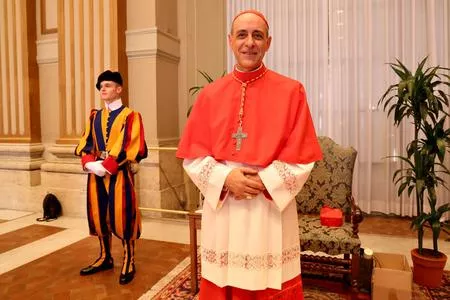
The dicastery’s prefect, Cardinal Victor Fernández, told the Register April 23 that he and his staff are “in the process of finalizing a new text with clear guidelines and norms for the discernment of apparitions and other phenomena.”
The cardinal, who met with Pope Francis in private audience on Monday, did not divulge any further details on the document, nor exactly when it will be published.
The last time the Vatican’s doctrinal office issued a general document on apparitions was in 1978, during the final months of the pontificate of Pope Paul VI.
In “Norms Regarding the Manner of Proceedings in the Discernment of Presumed Apparitions or Revelations,” the then-Sacred Congregation for the Doctrine of the Faith, headed by Croatian Cardinal Franjo Šeper, outlined the process the Catholic Church follows when investigating alleged apparitions or revelations.
The document stated that the Church’s responsibility is to first judge the facts, then permit public devotion if the examination is favorable, and finally make a judgment on the authenticity and supernatural character of the event.
The document outlined the positive and negative criteria for judging the authenticity of such phenomena, and when and how competent ecclesiastical authorities should be involved, including eventually the Holy See. It stressed that “extreme prudence” should be used when investigating the facts.
The most recent Vatican document regarding apparitions was issued in 2001 by the then-Congregation for Divine Worship and the Discipline of the Sacraments. In a “Directory on Popular Piety and the Liturgy: Principles and Guidelines,” the congregation drew on the Catechism of the Catholic Church and its references to private revelation.
That passage (No. 67) states that private revelations “do not belong … to the deposit of faith,” and adds that it is not their role to “improve or complete Christ’s definitive Revelation, but to help live more fully by it in a certain period of history.”
The Catechism adds:
“Guided by the Magisterium of the Church, the sensus fidelium knows how to discern and welcome in these revelations whatever constitutes an authentic call of Christ or his saints to the Church.”
Pope St. Pius X also touched on apparitions in his 1907 encyclical Pascendi Dominici Gregis, in which he stated that the Church exercises great prudence in this matter, allowing such traditions to be “narrated” only with caution and the disclaimer that the Church does not guarantee the truth of the facts narrated.
In an entry on “Private Revelations” written in 1913, the Catholic Encyclopedia stated that private revelations are constantly occurring among Christians, and that when the Church approves them, it declares only that there is nothing contrary to faith or morals, but does not impose an obligation to believe them.
Last month, the DDF released a “long-hidden” decree from 1951 which had declared the alleged 1948 apparition in the Philippines of the Virgin Mary in Lipa — also known as the Our Lady of Mediatrix of All Graces — was not supernatural.
For many years, the apparition has been a source of tension between those who have believed it to be authentic and the Catholic hierarchy in the Philippines.
The alleged apparition, in which the Virgin Mary reportedly appeared to a 21-year-old Discalced Carmelite postulant named Sister Teresita Castillo in Lipa City for 15 days beginning on Sept. 12, 1948, was investigated and was referred to Rome, after which the Vatican declared it wasn’t supernatural.
In a statement accompanying the publication of the decree, Cardinal Fernández noted how Mother Mary Cecilia of Jesus of the Discalced Carmelite convent in Lipa had, in 1951, confessed “to having deceived the faithful about the alleged apparitions in Lipa and consequently asked for forgiveness.”
The DDF made the 1951 decree public after a Dominican exorcist-priest, Father Winston Cabading, was sued in the Philippines for “offending religious feelings” after discrediting the Lipa apparition. A judge dismissed the case against him on the grounds of insufficient evidence.
This article was originally published on National Catholic Register.