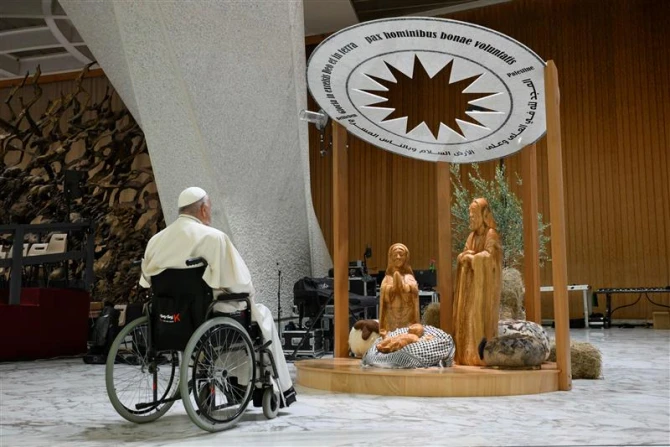
A Nativity scene made by artisans from Bethlehem was the source of controversy last week for including a Palestinian keffiyeh with the child Jesus in the manger — but according to the project’s organizer, the headscarf was a last-minute decision meant only to represent Palestinians.
The keffiyeh was visible during the presentation of the Bethlehem Nativity to Pope Francis in the Vatican’s Paul VI Hall on Dec. 7. By Dec. 11, four days later, the headscarf, manger, and Jesus sculpture had been removed from the scene without explanation.
Amid the Israel-Hamas war, the black-and-white checkered keffiyeh has become a symbol for the Palestinian cause. But Johny Andonia, a 39-year-old artist from Bethlehem who led the project, said it is just a symbol to represent or show the “existence” of Palestinians.
Matteo Bruni, director of the Holy See Press Office, told CNA the Vatican follows the tradition of placing the infant Jesus in the Nativity scene on the night of Christmas Eve. It is typical for the whole scene to be first presented to the pope before the Jesus statue is then removed, leaving behind the empty manger until the official start of Christmas.
Speaking to CNA by phone from Cyprus, where he has an art residency until May, Andonia said he did not expect the scale of the reaction to the keffiyeh, which he also signed off on, after it was approved by people at the Vatican during the Nativity’s installation on Dec. 5.
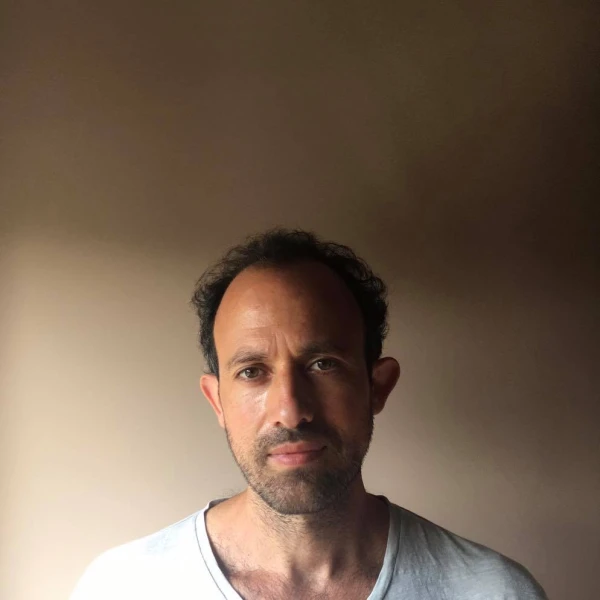
“It came about in a spontaneous way, actually, because we learned that the child baby Jesus has to be covered or even absent until the 24th of December, and [the on-the-ground coordinator] suggested to cover it with a keffiyeh,” the artist said on Dec. 13.
“And they said no, no, not to cover him. And then he asked, can I put it then under [the child Jesus] and the people … in charge at that time accepted laying the keffiyeh under the baby Jesus, and this is how it came about.”
Andonia said he does not agree with commentary from some quarters that the keffiyeh indicates violence or the eradication of others. “It’s only about recognition,” he said. “This keffiyeh represents the people who had presented the Nativity scene.”
He added that he does not think the Vatican will put the keffiyeh back when the manger and child Jesus are returned on Christmas Eve.
The Associated Press reported that the Israeli Embassy to the Holy See had declined to comment on whether it had complained about the keffiyeh or had asked for it to be removed.
Andonia, who is a physical artist and painter, was born in Jerusalem but has lived all his life in Bethlehem. He is a teacher at Dar al-Kalima University College of Art and Culture in Bethlehem.
After being contacted in April 2023 by the Palestinian Embassy to the Holy See in Rome about the idea for a Nativity from Bethlehem to be featured at the Vatican, Andonia said he decided to reach out to local artisans to create the structure from traditional materials, which he said have deep roots in the area, especially olive wood and mother-of-pearl.
The round, almost 10-foot-high installation, the work of over 30 artisans from Bethlehem, also incorporates stone, ceramics, glass, felt, and fabric.
Some evidence shows that the use of olive wood in Bethlehem dates back to the fourth century during the construction of the Basilica of the Nativity, Adonia said. And Franciscan monks introduced the use of mother-of-pearl in craftmaking to the area in the 17th century.
The Nativity is “a gift from the Bethlehemites,” he said.
Though not a religious person himself, the artist said being the bridge between the Vatican and the Bethlehem artisans has, nonetheless, been deeply meaningful for him.
“Most of [the people involved] were people of faith, and having their work at the Vatican with the pope, that was something [significant] for them,” he said.
“I’ve lived my life looking at people creating Nativity scenes, and they are proud of it, so it also meant something to me to be a part of it and give that opportunity to the individuals, and to support them even financially. The project was funded by the Palestinian Authorities, so it was also kind of a [financial] help, in this current situation, for them.”
This article was originally published on Catholic News Agency.